I saw Monster Head on the 8:15 PATH train from Journal Square, sitting on the last seat in the car, facing the door like everybody else who had mismanaged his life into commuting.
Journal Square had its usual morning mood: wet concrete, bad lighting, old tile, and the low civic hum of people trying not to make eye contact before Manhattan. It was the same station they dressed up as Osaka in one of the John Wick movies, which feels right. Jersey City has always been good at passing for somewhere stranger and more cinematic, especially before breakfast.
I was wearing khakis and a blazer, because life had punished me in ways I had not anticipated.
The car was half-full. Not crowded, not empty. Just that perfect commuter density where every person becomes an island with a phone. A guy in a Mets cap was asleep with his mouth open. A woman in nurse shoes stood near the doors even though there were seats. A student watched something on his phone without headphones, which should have been a felony, but this is America, and civilization has decided to die from the little cuts first.
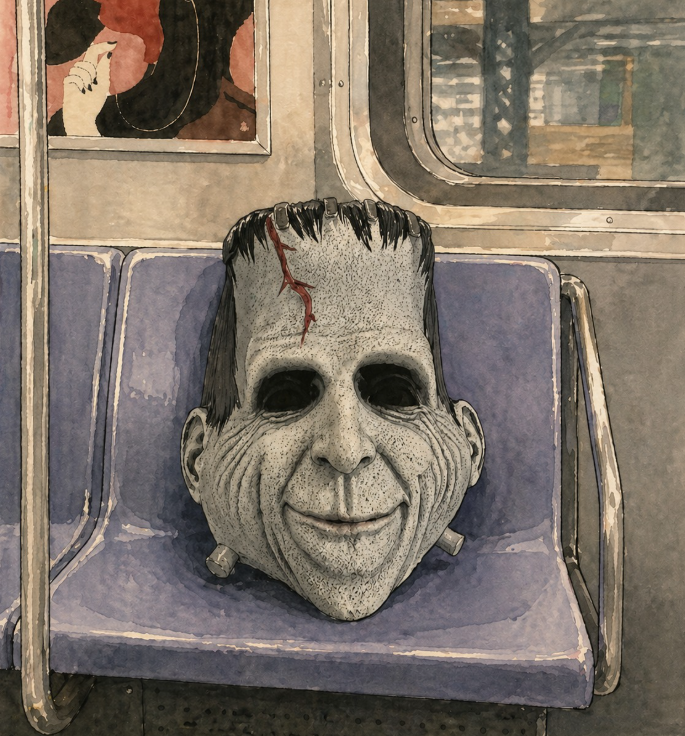
Not a man wearing the Monster Head. Not a body with a head. Just the head itself, the famous Herman Munster-style rubber mask from all the album covers and court exhibits and protest signs and blacklight posters thumbtacked above futons in rooms where people once said things like “society is the real toilet.” He was propped against the end panel, slightly tilted, the way a celebrity looks when trying not to be seen while also absolutely being a celebrity.
He was smaller than I expected.
That is the first terrible thing about seeing famous people in real life. They become measurable. For years they have lived in the part of your mind where movie monsters, dead presidents, cereal mascots, substitute teachers, and people who ruined your adolescence all sit in the same smoky lounge. Then you see them buying a protein bar at Newark Penn, or standing in line for TSA, or, in this case, taking the PATH from Journal Square to Christopher Street, and suddenly they have dimensions. They take up space. Not symbolic space. Actual space. One seat. Maybe one and a half if they are famous enough.
Monster Head had not been in the spotlight since the early nineties. There were rumors, naturally. There are always rumors when someone disappears. He had died in a motel. He had died in Berlin. He had died in the desert making that album of coyote screams and dial-up tones. He had overdosed three times, which, according to certain fans, only proved he was immortal. There had been a bitter divorce in the tabloids in the early oughts, though even then no one could agree whether he had been married to The Lady Who Carries Him, that Croatian performance artist, or that woman from Hackensack who appeared on Sally Jessy with him in the 90s. His kid got pinched on a weed possession charge in 2004, back when people still pretended weed was a social disease instead of a candle scent.
Mostly, though, Monster Head had been drama-free, which is not the same as peaceful. There are people who vanish because they are done with the world, and people who vanish because the world was never interesting enough to deserve them. Monster Head always seemed like the second kind.
I tried not to stare.
This is the choreography of seeing someone famous in New York. You recognize them, then you pretend you don’t. You glance, look away, glance again, look at an ad for laser hair removal, look back, pretend to check the map, then feel ashamed of your own eyes. You are aware of your face as an instrument of betrayal. You want them to know you know, but you do not want to be the kind of person who needs them to know you know.
It is delicate, almost Japanese, except uglier and with more brake dust.
The train pulled out of Journal Square with that PATH-train groan that sounds less like machinery than regret being dragged across tile. The windows became black mirrors. Everyone’s reflection appeared over everyone else’s reflection, so the car filled with ghosts of people standing two inches behind themselves.
Monster Head’s reflection hovered where his body should have been.
I had been a fan since seventh grade. Not openly, of course. Nobody was openly a Monster Head fan unless they were trying to get suspended, arrested, divorced, or booked at Maxwell’s. You discovered him through older cousins, blank cassettes, record-store clerks with t-shirts that barely hid their bellies, and kids whose parents let them watch cable after midnight. His album Spaces was the one that changed everything, though “changed everything” is one of those phrases critics use when they mean “made several damaged teenagers feel briefly elected.”
Spaces was Monster Head’s Purple Rain or Nebraska, depending on which guy at the counter of Vintage Vinyl you asked and how recently he had been dumped. It had the hits, if hits can be defined as songs everyone denied knowing the words to. “F*ck Machine” was the big one, the song that got asterisked and banned and then unbanned and unasterisked and then banned and asterisked again after a school board in Ohio read the lyrics aloud, thereby creating three thousand new Monster Head fans before lunch. “This World Is Bullshit” was the closer, seven minutes of organ, feedback, whispering, and what sounded like somebody throwing a lawn chair down a stairwell. (Turns out, that’s exactly what they used.) Many people believe Fiona Apple was referencing it in that infamous award speech, though this has never been proven, because most people will not admit to being Monster Head fans in public. Not even Fiona.
His lyrics were too suggestive. Too sexual. Too provocative. Too anti-everything. Even the love songs sounded like eviction notices. Even the political songs sounded like they had been written inside a microwave.
For years, liberals made him their poster head. He was the monster who told the truth. The latex prophet of disgust. The patron saint of college radio DJs who wore army jackets indoors. Then he released Brunch Is a War Crime, which called liberals “trash with tote bags” and “cowards hiding inside empathy like it was a furnished rental.” That ended his fellowship with the good people who bought organic salsa and said “problematic” before saying “hello.”
Then the conservatives tried to claim him. They always do this, eventually, with anybody who has insulted the right people. For three weeks Monster Head was the brave truth-teller they had been waiting for, until he released “The Flagpole Is Not Your Father,” still the most anti-conservative anthem ever accidentally played at a hockey game. After that, he belonged to no one again, which was where he seemed most comfortable.
The train hit Grove Street and a few people got on, including a man with a garment bag, a woman carrying flowers wrapped in brown paper, and two teenagers dressed in the expensive version of looking poor. Nobody looked at Monster Head. Or if they did, they looked the way New Yorkers look at all unusual things, which is to say they instantly calculated whether it was dangerous, expensive, or likely to delay them, and finding it none of those, returned to their phones.
I wanted to say something.
Not a fan thing. Not “your work meant so much to me,” which is what people say when they want to turn a stranger into a customer service counter for their own childhood. I wanted something casual, something that would signal, with perfect restraint, that I knew Spaces front to back, including the hidden track after “Soft Furniture for Hard People,” and that I understood the difference between Monster Head fans and the late-wave irony crowd that discovered him through the documentary “Headroom: The Monster Head Story”, which was mostly lies and footage of people who had never been there.
Maybe just a nod.
But what nod? The nod of equals? Ridiculous. The nod of worship? Obscene. The nod of a man in khakis who once had a poster of Monster Head taped to a closet door with Scotch tape and has since become something with dental insurance? Unforgivable.
The train left Grove and entered the tube.
That’s when the old PATH feeling arrived, the under-river hush. The car got quieter in that strange way subway cars get quieter when they are fully in motion. The noise becomes so total it starts to feel private. You can hear the rails, the air, a backpack zipper, somebody’s gum, your own life failing to explain itself.
I looked at Monster Head again.
He was facing forward. His rubber eyelids drooped. His greenish-gray forehead had the same fake stitches from the Spaces cover, though they were more cracked now. The neck hole had collapsed inward. There was a shine on him, not clean exactly, but maintained. Preserved. He had the dignity of something that had survived basements, spotlights, subpoenas, and storage units.
The train came to an abrupt halt.
Not a normal halt. A PATH halt. A municipal seizure. Everyone’s body moved before anyone’s face admitted concern. I lost my balance and dropped into an empty seat across the aisle, bumping my shoulder against the partition. The Mets cap guy woke up and looked offended by physics.
Monster Head was gone.
For one terrifying second the seat was empty, and I felt the disproportionate panic of someone who has lost a celebrity he does not know.
“Anyone?” said a voice.
It came from below.
Monster Head had rolled off the seat and into the corner at the front of the car, beside one of those giant paper soda cups from Boulevard Drinks, the kind with a lid that never quite fits and a straw that looks engineered for industrial coolant. He was wedged against the metal panel, face-up, indignity radiating from him in waves.
A couple of people moved to help, but the train started again and Monster Head began rolling toward the back of the car.
Not fast. Not dramatically. Just rolling.
Nobody screamed. Nobody took video. Nobody said, “Is that Monster Head?” The nurse-shoe woman lifted her bag. The garment-bag man stepped aside. The teenagers smiled in the sealed, bored way teenagers smile when something is almost interesting but not enough to become vulnerable over.
I reached out, too late.
The Lady Who Carries Him got there first.
She appeared from the opposite seat with the quiet authority of someone who has spent forty years preventing a famous rubber head from touching contaminated surfaces. She wore the white burka-like garment from the old tours, cinched with the red belt, the same one I remembered from concert footage, fan photos, and a grainy bootleg poster from the Madison Square Garden show in 1992. The costume had not changed. Hopefully it had been washed since. I am not a cruel man, but hope is free.
She lifted him with both hands, not tenderly but correctly, the way a museum handler lifts an artifact that has opinions. She plucked a straw wrapper from the side of his mouth. He spat once, though I do not know from where.
“Motherfucker,” he said.
The Lady Who Carries Him placed him back on the seat.
He turned toward me.
I froze. The eyes in the mask were black holes cut into rubber, but I felt seen by them, which is worse than being seen by eyes. Eyes can be fooled. Holes just receive you.
“The fuck you lookin’ at, normie?”
It is difficult to describe what happens when your idol identifies you correctly.
“Nothin’,” I said.
My voice came out too small, like it had been printed on a receipt.
“Fuckin’ normies can’t keep your eyes in your heads,” he muttered. “I’ll fuckin’ chew them out.”
He kept mumbling, a low furious trickle. Something about office haircuts. Something about tote bags. Something about men who tuck in shirts and “think a podcast is a soul.” A few people looked up, then looked down again. Nobody wanted to be involved. This, too, is a New York courtesy.
I turned away, humiliated.
Normie.
There it was. The worst thing you can be called by Monster Head. Worse than being called a poseur by a metalhead. Worse than tourist. Worse than cop, because at least a cop had chosen a side. “Normie” entered the Monster Head lexicon in 1989 with “Fuck the Normies,” an anthem or a threat depending on whether your parents owned property. In my school, it was scripture. We wrote it on desks. We carved it into our notebooks. We said it, without pain, about anyone who liked Bon Jovi. I had been the biggest Headcase in my grade, possibly the whole district. That was the word then: Headcases. Not fans. Fans were for baseball teams and sitcoms. Monster Head had Headcases, and Headcases knew the secret headshake, the bootleg catalog numbers, the rumor that the first pressing of Spaces contained a different scream on side two.
I was a Headcase in a school full of normies.
And now I was on the PATH train in khakis, carrying a laptop murse, heading to an office where we used the word “deliverables” without anyone being struck by lightning.
I looked at my reflection in the window. The black glass gave me back a man whose childhood would not have returned his calls.
At Christopher Street, the train exhaled. The doors opened. The smell changed, as it always does there, from tunnel-metal and Jersey damp to West Village perfume: old brick, bakery sugar, dog urine, money, rain trapped in trees.
The Lady Who Carries Him stood. She moved slower than she must have once moved, but she had the balance of duty. She placed Monster Head on a shallow carrying platter with two chrome handles, the kind of thing you might use to serve a Thanksgiving turkey if the turkey had once testified before Congress. The red belt around her white garment flashed as she turned.
Monster Head faced the platform.
For a second, I thought he might look back at me with recognition, or forgiveness, or a second insult that would be more personal and therefore more intimate.
He didn’t.
The Lady Who Carries Him carried him out.
The doors closed.
The train continued toward Ninth Street, then Fourteenth, then the office universe, where everything unusual is made into a calendar invite and killed.
By the time I got to work, the sighting had already begun to decay inside me. This is another terrible thing about seeing famous people. The event is never as solid afterward as it was while happening. Reality starts negotiating with memory. Did he really say “normie”? Was that actually The Lady Who Carries Him? Was the rubber gray or green? Was it even Monster Head, or just some artifact from a Halloween store that had slipped the leash of meaning?
I told Ibrahim in the next cubicle anyway.
“You know Monster Head?” I said.
He looked up from his monitor. “Is that a game?”
“No. Monster Head. From Spaces.”
“What spaces?”
“The album.”
“By who?”
“Monster Head.”
He blinked with the gentle patience of a man trapped near someone else’s enthusiasm.
I pulled up my playlist.
This should have been the moment. Every believer imagines this moment. You introduce the uninitiated to the forbidden text and watch their face change. I played “F*ck Machine,” the asterisked version, because Spotify didn’t dare carry the unasterisked one, at a low volume, because HR existed and because courage, like youth, is a resource you only understand after wasting it. The opening came through the tiny speaker on my phone, tinny and embarrassed. It sounded smaller there, stripped of basement acoustics and adolescent danger. It sounded, if I am honest, a little like a washing machine threatening a saxophone.
Ibrahim listened for eleven seconds.
“This is old?” he said.
“Classic,” I said.
He nodded.
Not agreement. Workplace nodding. The nod that means: I am returning to my spreadsheet now.
I tried Marta from accounts. She had never heard of him. I tried Brian, who once told me he liked weird music, but apparently by weird he meant a band with a trumpet. Nobody knew Spaces. Nobody knew “This World Is Bullshit.” Nobody remembered the congressional hearings, the Riot at Paramus, the Fiona Apple theory, the summer MTV almost played the video and then cut to commercials for Sprite. Nobody had ever seen the poster where Monster Head was floating above a suburban cul-de-sac while children in pajamas saluted him with forks.
I previewed a few songs. Not too much. You can feel an office rejecting a thing. The air changes. People become polite in formation.
“That’s funny,” someone said, which is what adults say when they want art to leave.
I went back to my desk.
My phone still showed the album cover: Monster Head against a field of black, the word SPACES written above him in cheap cosmic lettering, as if the universe had been designed by a guy selling T-shirts in a mall. I stared at it longer than I meant to.
The first call of the day came in.
I put on my headset. My screen filled with the customer’s account. My voice changed automatically into the voice I use to be employed.
“Thank you for calling,” I said. “How can I help you?”
Outside, somewhere beneath the river or above it, Monster Head was being carried through the city on his platter, past coffee shops and scaffolding and people who did not know they were lucky to be passing him. Maybe he had an appointment. Maybe a rehearsal. Maybe he was going home. Maybe there was no Monster Head, no Spaces, no Headcases, no Lady Who Carries Him, only a man on a train seeing the last rubber scraps of his former self roll across a dirty floor.
But that seemed unlikely.
The second track came into my head then, uninvited, as old songs do when they are not finished with you. Not the chorus. Not the famous part. Just the little bridge before the noise collapses, the part only real Headcases remember, the part no one ever quotes because to quote it would be to admit you had been there.
“There’s no room in space / and no space in rooms / I was born in the hallway / between two doomed wombs.”
I mouthed the words silently while the caller explained his problem.
No one in the office noticed.
P.