This month in SCREW history:
In March 1973, a lovable gorilla made his first public appearance on the cover of SCREW #212. Eight years later, artist Leslie Cabarga’s cheeky ape would help become the face of Nintendo…
As you load up your next round of Mario Kart, you probably already know Mario’s story begins with Nintendo’s smash-hit arcade game Donkey Kong. What you may not know is that Mario’s iconic ancestor first showed up on the cover of SCREW. Call it the Six Degrees of SCREW. Call it SCREW’s Law. Whatever it its, call it proof that, sooner or later, every road in pop culture seems to run through a dirty little magazine on 42nd Street.
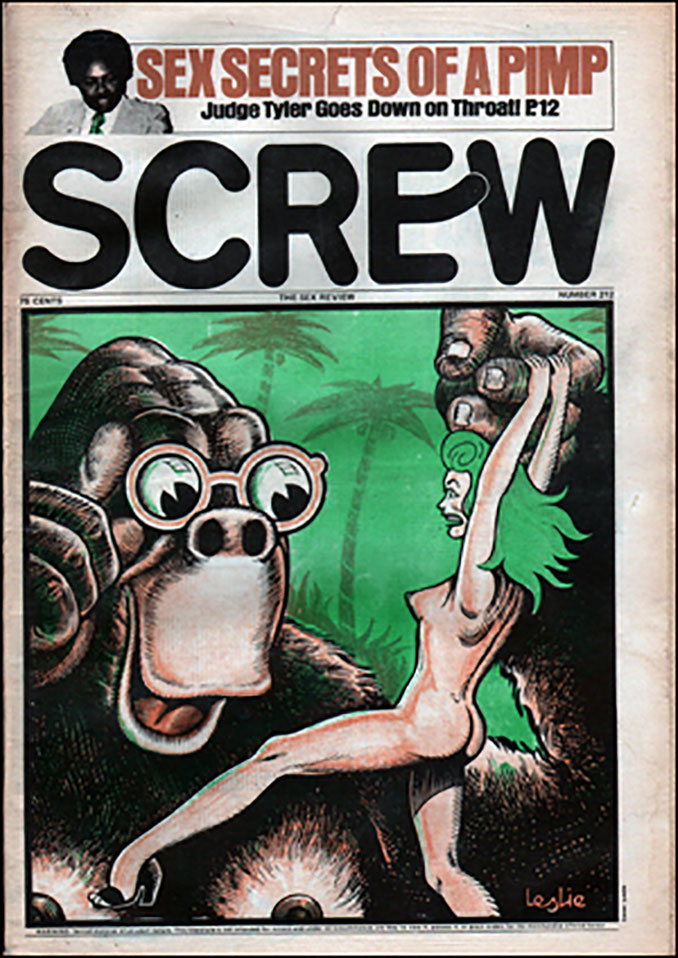
Artist Leslie Cabarga began selling his cartoons to underground newspapers in and around New York City at just 14. Through the 1970s, his distinctive 1920s-and-’30s-inspired style landed his work in the pages and on the covers of publications like East Village Other, Rat Subterranean News, Gothic Blimp Works and, of course, SCREW. He was only 19 when he created his “King Kong” cover for SCREW #212, introducing the world to the lovable gorilla that, in our preferred telling, would one day become Donkey Kong.
The seed was planted.
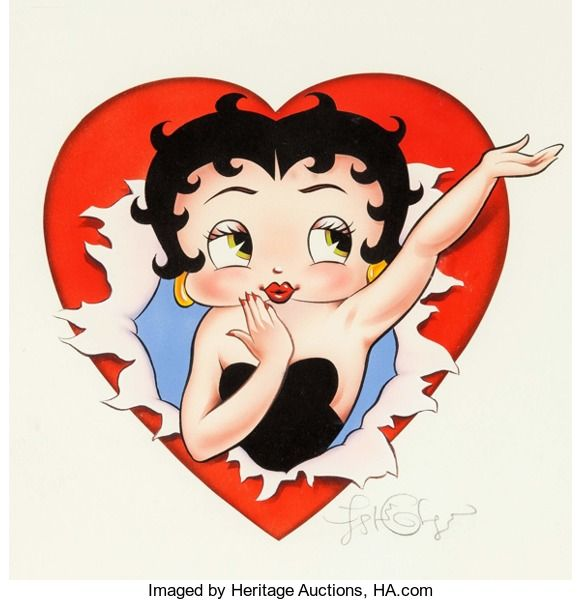
After that, Cabarga moved to San Francisco, where he published comics in San Francisco Comic Book, Yellow Dog, Comix Book and several other notable underground titles, along with National Lampoon. He later landed art director jobs at Rolling Stone, Outside and Rock magazines. His work would eventually appear on the covers of Time, Newsweek and Fortune, among other heavy hitters. He also illustrated the cover of the J. Geils Band’s 1982 album Showtime, designed the logo for Tetris, and helped revive the career of everyone’s favorite whore, Betty Boop.
In 1980, a little-known Japanese company called Nintendo set up shop in New York City and Seattle. Nintendo of America was born. Fresh from Tokyo, its all-male staff reportedly felt right at home in the hustle and grime of Manhattan, especially around the peep shows and skin palaces of West 42nd Street, where they soon encountered the familiar pages of SCREW, which was also being published under license in Japan at the time. According to late SCREW founder Al Goldstein, who often ushered his new Japanese friends through the city’s after-hours demimonde, the magazine was a staple in Nintendo of America’s orbit (for obvious reasons beyond the scope of this story). In fact, the first and only SCREW subscribers in Washington State were said to be Nintendo employees in Seattle.
In July 1981, Nintendo of America released its coin-op arcade game Donkey Kong to the U.S. market. Designed by first-time video game creator Shigeru Miyamoto, the game was packaged for American audiences with bold marquee and cabinet artwork by illustrator Leslie Cabarga, whose lovable gorilla helped give Donkey Kong its early visual identity. Cabarga, whom Nintendo had discovered through his work with SCREW, also created the first Americanized promotional rendering of the character then known in Japan as “Jumpman,” helping shape the familiar image that would soon become Mario. The character’s name, of course, came from Mario Segale, the landlord of Nintendo’s Seattle office.
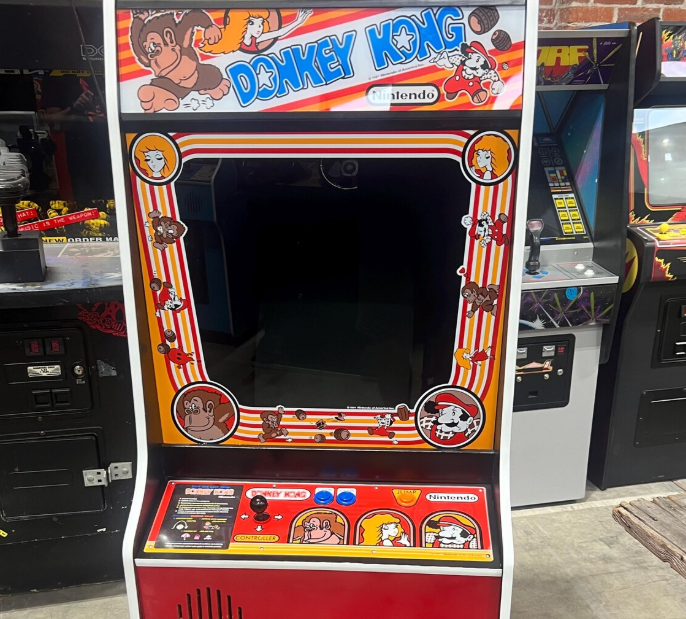
Donkey Kong became Nintendo’s first international smash, generating more than $280 million in its first year and helping pull the company back from the brink. Through the 1980s and into the ’90s, Donkey Kong was everywhere: arcades, ColecoVision, shirts, hats, backpacks, lunchboxes, toys, whatever surface could carry a licensing deal. Like Pac-Man, his biggest competitor at the time, the character was slapped onto just about everything that wasn’t nailed down. Then came Donkey Kong Jr., Donkey Kong II and, of course, Super Mario Bros., which, together with the NES, spawned more than 200 games, endless merchandise, cartoons, movies and an empire that would make Mario the most successful video game franchise of all time.
And to think, it all started with a lovable gorilla on the cover of SCREW, tucked beneath the heading “Sex Secrets of a Pimp.” That’s our story and we’re sticking to it. Maybe the better title was always “Nintendo’s Shady Past.” After all, realizing that something as wholesome as Donkey Kong, Nintendo and Mario, with all the lunchboxes, toys and kid-friendly spinoffs that followed, sits just a couple degrees away from a porn magazine is a little like finding out dear old Grandpa spent his youth hanging around Times Square in a trench coat.
Oh, but he did.
Today, Leslie Cabarga lives in Southern California. He’s pushing 70, lives in a custom-built tiny house, and has long since shifted from illustration to carpentry and cabinet-making. He also plays ukulele and piano with the California State Old-Time Fiddlers’ Association.